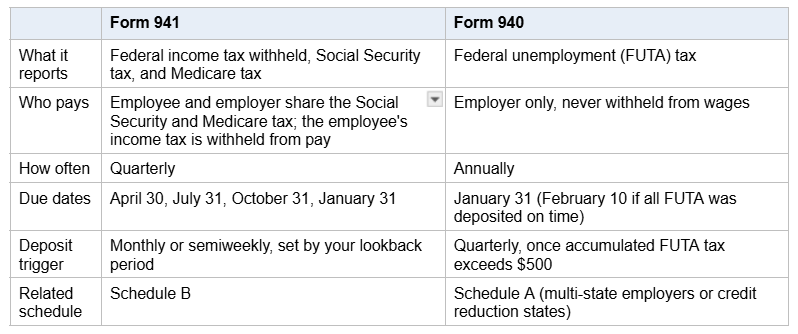
Form 941 is the quarterly return for the income tax, Social Security tax, and Medicare tax you withhold from employee paychecks, plus your matching share. Form 940 is the annual return for federal unemployment tax (FUTA), which only you pay and never withhold. If you need help, our payroll tax filing and accounting services team can prepare and submit it for you. The bigger risk is usually the deposits, because unpaid payroll taxes can become a personal debt.
What is the difference between Form 940 and Form 941?
A simple way to keep them straight: Form 941 is about money that passes through your payroll every pay period, and Form 940 is about a separate employer-only tax you report once a year. Most employers with employees file both. Two points cause most of the confusion. First, FUTA is never taken out of an employee’s wages, so it does not appear on a pay stub. Second, Form 941 covers both sides of the relationship: the money you hold for your employees and the matching Social Security and Medicare tax you owe as the employer.
What is Form 941 and who has to file it?
Every employer that withholds federal income tax from wages or pays Social Security or Medicare tax files Form 941 each quarter. The current revision is dated March 2026. If you have even one employee on payroll, assume you are in this group.
For 2026, the rates are:
Social Security tax: 6.2% from the employee and 6.2% from the employer, on wages up to $184,500 per employee.
Medicare tax: 1.45% from the employee and 1.45% from the employer, with no wage cap.
Additional Medicare Tax: 0.9%, withheld from the employee only, once that employee’s wages pass $200,000 in the calendar year.
The Social Security Administration has announced that the 2027 wage base rises to $192,300. The IRS publishes the full set of 2027 figures in Publication 15 each December.
Form 944 for very small employers
Form 944 is an annual return for employers whose total employment taxes will be $1,000 or less for the year. You do not choose it. You file Form 944 only if the IRS has notified you in writing to do so. Everyone else files Form 941 every quarter.
Form 941-X for corrections
If you find a mistake on a return you already filed, you correct it on Form 941-X rather than filing a second Form 941. The IRS instructions explain how.
Form 941 due dates by quarter
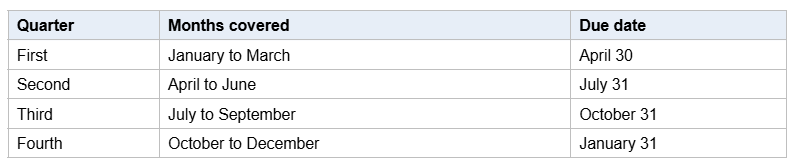
Form 941 is due on the last day of the month after each quarter ends:
If you deposited all of the quarter’s taxes in full and on time, you get a short extension: you may file by the 10th day of the second month after the quarter ends. A due date that lands on a weekend or federal holiday moves to the next business day (see IRS Publication 509 for the calendar rules).
You must now make balance-due payments electronically with Form 941, and the IRS issues refunds by direct deposit unless you apply the overpayment to your next return. The IRS instructions for Form 941 also explain where to file. Mailing addresses depend on your state and on whether you are enclosing a payment, so check the “Where to file” section of the instructions instead of relying on an address you found elsewhere.
What is Form 940 and how does FUTA work?
FUTA tax is 6.0% on the first $7,000 of each employee’s wages for the year. Employers who pay their state unemployment tax on time receive a credit of up to 5.4%, which brings the net federal rate down to 0.6% in most states. In practical terms, that is a maximum of $42 per employee for the year when the full credit applies.
You must file Form 940 if either of these tests is met in the current or prior calendar year:
You paid $1,500 or more in wages in any calendar quarter, or
You had one or more employees for some part of a day in 20 or more different weeks.
When it is due. Form 940 is due January 31. When that date falls on a weekend, the deadline moves to the next business day: the 2025 return was due February 2, 2026, because January 31 fell on a Saturday. If you deposited all of your FUTA tax when due, you have until February 10.
When you deposit. You must deposit FUTA quarterly once your accumulated liability exceeds $500.
Credit reduction states
Some states carry unpaid federal unemployment loans, and employers there lose part of the 5.4% credit. For 2025, according to the Department of Labor notice on FUTA credit reductions, only California (1.2%) and the U.S. Virgin Islands (4.5%) were affected. Michigan and Florida employers were not affected. The Department of Labor publishes the list for 2026 in November, so check it before you file your 2026 Form 940.
Payroll tax deposits: monthly vs. semiweekly
Filing a return does not pay the tax. You pay payroll taxes by making deposits throughout the year, and the deposit rules are stricter than the filing rules.
Your deposit schedule depends on your lookback period, a past reporting window the IRS uses to measure how much employment tax you reported. If you reported $50,000 or less, you are a monthly depositor. If you reported more than $50,000, you are a semiweekly depositor.
For semiweekly depositors, the deadline follows your payday:
Paydays on Wednesday, Thursday, or Friday: deposit by the following Wednesday.
Paydays on Saturday, Sunday, Monday, or Tuesday: deposit by the following Friday.
Two other rules matter:
The $100,000 rule. If your accumulated taxes reach $100,000 or more on any day in a deposit period, you must deposit by the next business day.
The $2,500 rule. If your total taxes for the current or prior quarter are under $2,500, you may pay with the return instead of making deposits.
All federal tax deposits must be made electronically, through EFTPS, IRS Direct Pay, or your business tax account. The IRS’s Publication 15 (Circular E) lays out the full deposit rules. For a plain-English walkthrough, see our guide on when to deposit payroll taxes.
What happens if you file or deposit late?
Deposits fail for ordinary reasons: a cash crunch in a slow month, a payroll provider change, a missed electronic payment, or thinking filing the return counts as payment. None of those stops the clock. The deposit is due when the schedule says it is due, whether or not the return has been filed yet.
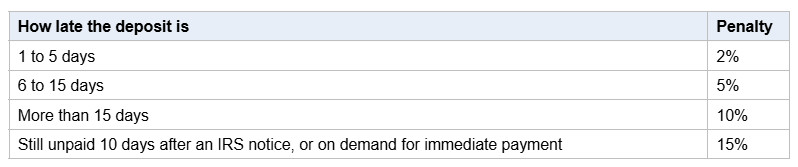
Late deposits trigger the failure-to-deposit penalty under Internal Revenue Code section 6656. It is a percentage of the amount deposited late, and it rises with the delay:
The Trust Fund Recovery Penalty
The most serious consequence is not a percentage. Income tax withheld from employees and the employee’s share of Social Security and Medicare tax are called trust fund taxes, because you hold them in trust for the government. If you don’t pay them over, the IRS can assess the Trust Fund Recovery Penalty under Internal Revenue Code section 6672. The penalty equals the unpaid trust fund amount, and it is assessed against individuals, not just the business.
Three things to know:
A responsible person is anyone with the duty and power to direct how trust fund taxes are collected, accounted for, and paid. That turns on duty and power, not on job title.
Willful does not require bad intent. Paying other creditors instead of the IRS can be enough.
Before the IRS assesses the penalty, it sends a written proposal, and you have 60 days to appeal (75 days if the letter is addressed outside the United States).
Michigan. Federal Forms 940 and 941 are only part of the picture. Michigan employers also must report state withholding and unemployment insurance. The rules and rates differ from federal ones, so confirm them directly with the state agencies.
Florida. Florida has no state income tax, so there is no state income tax withholding. Florida employers owe reemployment tax, Florida’s state unemployment tax, administered by the Florida Department of Revenue. Timely state payments also earn the federal FUTA credit described above.
One related risk applies in both states: misclassifying workers. If you treat workers as contractors when they should be employees, you may be liable for payroll taxes that should have been withheld and reported on Form 941. Our guide on how to avoid misclassifying employees covers the basics.
Frequently asked questions
What is the difference between Form 940 and Form 941?
Form 941 is the quarterly return for federal income tax withheld from employees plus both halves of Social Security and Medicare tax. Form 940 is the annual return for federal unemployment (FUTA) tax, which only the employer pays and never withholds.
When is Form 941 due?
April 30, July 31, October 31, and January 31 for the four quarters. If every deposit for the quarter was made on time, you have until the 10th day of the second month after the quarter ends.
Who has to file Form 940?
Any employer that paid $1,500 or more in wages in any calendar quarter, or had at least one employee in 20 or more different weeks, in the current or prior year. The net FUTA rate is usually 0.6% on the first $7,000 per employee after the state credit.
What happens if I don’t make my 941 deposits on time?
The IRS charges a failure-to-deposit penalty of 2%, 5%, or 10% depending on how late the deposit is, rising to 15% after a notice. The IRS can also assess unpaid withheld taxes personally against responsible owners or officers through the Trust Fund Recovery Penalty.
Can a small business file Form 944 instead of Form 941?
Only if the IRS has notified you to file Form 944, which applies to employers with annual employment taxes of $1,000 or less. Everyone else files Form 941 quarterly.
Behind on 941 deposits? Talk to Levy & Associates
Tell us which return, which quarter, and whether you have received an IRS notice. If you missed deposits, received a payroll tax notice, or aren’t sure what you owe, the safest move is to get the facts before the IRS sets the timeline. Our team includes attorneys, Certified Public Accountants, Enrolled Agents, and former IRS Revenue Officers who work on payroll tax problems every day.
Client testimonials on this page reflect individual experiences. Prior results do not guarantee a similar outcome. Every case turns on its own facts. No outcome is guaranteed. This page is general information, not legal, tax, or employment advice. Reading it does not create an attorney-client relationship. Levy & Associates handles civil tax matters only and does not represent clients in criminal tax matters of any kind.
Contact Levy & Associates for Dependable Tax Audit Services
Levy & Associates is available for free initial consultations. We’re happy to answer any questions you have about the audit process or address any concerns about your specific situation.
There’s never a good time to be audited, and the time-consuming process will take away from your business or family if you try to face it alone. Let us handle and coordinate communication, so you can return to your daily life.