Can Unpaid Taxes Send You to Jail? What Civil Collection Actually Looks Like
Share
No. Owing the IRS money you cannot pay is not a crime. The IRS handles unpaid taxes through civil collection: notices, penalties, interest, liens, levies, and payment arrangements. Prison enters the picture only when someone willfully breaks a criminal tax law, such as hiding income or assets to avoid paying. If you are behind and worried, the practical question is not whether you will be arrested. It is how to resolve the balance, and civil tax resolution for unpaid taxes is built for exactly that. Levy & Associates handles civil tax matters only and does not represent clients in criminal tax matters of any kind.
Can you go to jail for not paying taxes?
Not for being unable to pay. An unaffordable tax bill is a debt, and the IRS collects debts through civil tools. It doesn’t bring criminal charges because the balance is large or because you ran out of money.
Criminal tax statutes turn on one idea: willfulness. That means a voluntary, intentional violation of a known legal duty. The difference is easy to see in two examples.
Honest inability to pay. You filed your return, reported your income accurately, and then couldn’t pay the bill because of a job loss, a medical event, or a slow year in your business. That is a civil collection matter.
Willful evasion. You concealed income, moved money to hide it from the IRS, or put assets in someone else’s name to keep them out of reach. Criminal prosecutors look specifically for that type of conduct.
Mistakes are a third category. Honest errors on a return lead to letters, audits, and possibly civil penalties. They are not crimes. Most tax problems are civil, and most people who owe the IRS never come near a criminal investigation.
It helps to know what “willful” does and does not mean. Being late, short on cash, or misunderstanding a rule does not, by itself, show a willful violation. The word points to a deliberate choice to break a duty you knew you had. That is why two people with the same balance can face very different treatment: one is working through a hardship, and the other is trying to keep money away from the government.
The IRS also must give you written notice before it takes most enforcement steps. You do not wake up to a criminal case because a bill went unpaid. You receive letters first, and each letter carries deadlines that protect your rights.
What the IRS actually does when you owe: the civil collection path
When a balance goes unpaid, the IRS follows a sequence that is mostly paperwork and money, not arrests.
Bills, penalties, and interest. The IRS sends a bill, then reminder notices. Two civil penalties usually start to build:
The failure-to-pay penalty is 0.5% of the unpaid tax for each month or partial month, up to 25% of the unpaid tax. It rises to 1% per month if the tax is still unpaid 10 days after the IRS sends a notice of intent to levy. It drops to 0.25% per month while an approved payment plan is in place, if you are an individual who filed your return on time. The IRS failure-to-pay penalty page lays out each rate.
Interest accrues on the unpaid balance and any penalties until you pay in full.
Liens and levies. A lien is a legal claim against your property for the debt. A levy is the actual seizure of money or property, such as funds in a bank account. Before levying most assets, the IRS must give you written notice of your right to a hearing at least 30 days ahead. That hearing is called a Collection Due Process hearing under Internal Revenue Code section 6330, and you should not miss the 30-day window. If you received an IRS notice of levy, read it the same day for its deadlines.
A time limit on collection. The IRS generally has 10 years from the date a tax is assessed to collect it under Internal Revenue Code section 6502. Certain events can pause that clock, so the real deadline depends on your case.
Other consequences that feel like punishment but are civil. Two come up often:
The IRS can apply your federal tax refund to a balance you owe.
For 2026, the IRS can certify a “seriously delinquent” tax debt of more than $66,000 to the State Department, which can affect a passport. Our guide to passport certification for tax debt over $66,000 explains how it works.
None of these are criminal sanctions. Civil penalties are money added to your balance. They don’t result in a conviction or create a criminal record.
What to do when a notice arrives. Read it the day it comes, find the response deadline, and do not set it aside. Many IRS notices carry a fixed window, and the notice of intent to levy carries the 30-day hearing window described above. If you hire a representative, they file a power of attorney on Form 2848, which allows the IRS to communicate with them about your account. Ignoring notices is a common way a manageable balance becomes a levy.
Can you go to jail for not filing taxes?
Filing is different from paying, and the law treats it differently. Willful failure to file a required return is a misdemeanor under Internal Revenue Code section 7203. The maximum penalty is up to 1 year in prison, a fine of up to $25,000, or both, and the offense requires willfulness. IRC 7203 makes that requirement explicit.
In practice, most people who fall behind on filing are handled civilly:
The failure-to-file penalty is 5% of the unpaid tax for each month the return is late, up to 25%. For returns due after 2025, a return filed more than 60 days late also carries a minimum penalty of the lesser of $525 or 100% of the tax due.
If you don’t file, the IRS can prepare a substitute return for you, which usually produces a larger bill than one you prepare yourself.
If you are worried about not filing taxes for several years, the practical answer is the same: file the missing returns. Filing is the civil path back to compliance, and the IRS will not agree to most resolutions until you are current. Our guide on how far back the IRS can go for unfiled returns explains which years matter.
Where the criminal line sits (context only)
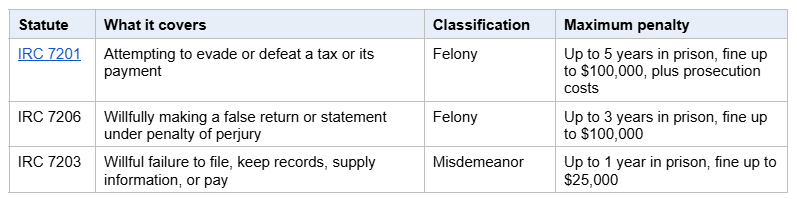
This section is here so you can see where the line is, not so you can act on it. Three federal statutes cover most of what people mean by “tax crimes,” and each requires willful conduct.
Civil fraud is a separate track. Under Internal Revenue Code section 6663, the IRS can add a 75% civil penalty to the portion of an underpayment caused by fraud, without any prosecution.
How do criminal cases begin? Some start with tips or referrals from other agencies. Others start inside the IRS, when a revenue agent, revenue officer, or investigative analyst detects possible fraud and refers it to IRS Criminal Investigation. The IRS describes this on its page on how criminal investigations are initiated.
Important: If you believe you may be under criminal investigation, speak with a criminal tax defense attorney. Levy & Associates does not represent clients in criminal tax matters of any kind.
How people who cannot pay actually resolve their tax debt
Most people who owe the IRS resolve the balance with one of a handful of civil options. The right option depends on your finances, not how much you wish to pay.
Installment agreement. This is a monthly payment plan. Individuals can apply online for a long-term plan if they owe $50,000 or less in combined tax, penalties, and interest and have filed all required returns. Larger balances generally require a financial disclosure. The IRS payment plans page lists current eligibility, and our page on requesting an installment agreement with Form 9465 covers the request form.
Currently Not Collectible status. If paying would leave you unable to cover basic living expenses, the IRS can pause active collection. This does not erase the debt. Penalties and interest keep accruing, and the collection clock keeps running. Read how to qualify for Currently Not Collectible status before assuming it applies to you.
Offer in compromise. An offer in compromise can settle a debt for less than the full amount, but only when your finances genuinely support it. The IRS bases its decision on what it could reasonably collect from you, and acceptance is never assured. In fiscal year 2025, the IRS accepted 5,464 of the 38,797 offers submitted, about 14% (IRS Data Book). Be wary of anyone who promises a settlement before reviewing your numbers.
Penalty abatement. With reasonable cause, penalties can sometimes be reduced or removed, and first-time penalty abatement may apply to taxpayers with a clean prior record. This lowers what you owe, but not the underlying tax.
A note on “Fresh Start”: you may see it advertised as a separate program. It expanded existing options, such as installment agreements and offers in compromise, rather than being a standalone application.
No single option is right for everyone. A retiree on a fixed income and a business owner with a payroll balance face very different choices, and the right answer starts with an honest look at income, expenses, and assets.
One step comes before all of these: getting current on filing. The IRS will generally not finalize a resolution while required returns are missing, so any unfiled years are addressed first. After that, the work is matching the option to your actual numbers, preparing the financial disclosure the IRS requires for larger balances, and negotiating terms you can keep. Defaulting on an agreement can reopen collection, so a sustainable arrangement matters more than the lowest payment the IRS might accept on paper.
Frequently Asked Questions
Can you go to jail for not paying taxes?
Not for being unable to pay. The IRS handles unpaid taxes through civil collection: penalties, interest, liens, levies, and payment arrangements. Criminal charges require willful conduct such as evasion or deliberate failure to file or pay.
Can you go to jail for not filing taxes?
Willful failure to file is a misdemeanor under IRC 7203, with up to 1 year in prison. Most late filers are handled civilly, with a failure-to-file penalty of 5% per month up to 25%, and filing the missing returns gets you back into compliance.
How much do you owe the IRS before you go to jail?
No dollar amount triggers jail. Criminal statutes turn on willfulness, not the size of the balance; a large balance you cannot pay is a civil collection matter.
What happens if you owe the IRS and cannot pay?
The IRS sends notices, adds penalties and interest, and can file a lien or levy after required notice. Options include an installment agreement, Currently Not Collectible status, or an Offer in Compromise, which the IRS accepted in about 14% of cases in FY2025.
What is the difference between civil and criminal tax penalties?
Civil penalties are money added to your balance, such as the failure-to-pay penalty or the 75% civil fraud penalty. Criminal penalties require proof of willful conduct and can include fines and prison time. Levy & Associates handles civil matters only.
Owe the IRS and cannot pay? Talk to Levy & Associates about civil resolution
If you owe the IRS, a sensible first step is to understand your real options before a deadline passes. Our team includes Michigan- and Florida-licensed attorneys, Certified Public Accountants, Enrolled Agents, and former IRS Revenue Officers. Federal law under Treasury Department Circular 230 governs representation before the IRS, which allows attorneys, CPAs, and Enrolled Agents to represent taxpayers before the agency.
Levy & Associates handles civil tax matters only and does not represent clients in criminal tax matters of any kind. This page is general information, not legal, tax, or employment advice. Reading it does not create an attorney-client relationship. Prior results do not guarantee a similar outcome. Every case turns on its own facts. No outcome is guaranteed.
Contact Levy & Associates for Dependable Tax Audit Services
Levy & Associates is available for free initial consultations. We’re happy to answer any questions you have about the audit process or address any concerns about your specific situation.
There’s never a good time to be audited, and the time-consuming process will take away from your business or family if you try to face it alone. Let us handle and coordinate communication, so you can return to your daily life.