Can the IRS Take Your Social Security Check? What Michigan and Florida Retirees Must Know
Share
Yes, but with limits. Through an automated system called the Federal Payment Levy Program (FPLP), the IRS can take up to 15% of your Social Security retirement and survivor benefits to pay an unpaid tax debt. Disability insurance (SSDI) and Supplemental Security Income (SSI) are treated differently, and you can stop a levy once it starts.
If you live in Oakland County or Palm Beach County and a deposit came in short or you received an IRS notice, this guide explains what the IRS can and cannot take, how much warning it must give, and what to do next. A levy is the legal seizure of income or property to pay a tax debt. For the broader picture, see our page on IRS levy help for Social Security recipients.
How an IRS levy on Social Security works
The FPLP matches the IRS’s list of unpaid tax accounts against federal payments scheduled by the Treasury Department, including Social Security. When your account matches, the IRS can levy up to 15% of each payment, or the exact amount you owe if that is less. Under Internal Revenue Code section 6331, this kind of continuing levy attaches to up to 15% of each payment.
Before the levy is transmitted, the IRS sends a final notice of intent to levy, giving you 30 days to respond, as described on the IRS Federal Payment Levy Program page. Once the levy starts, it repeats with each payment until you pay the debt, reach an arrangement with the IRS, or the IRS releases the levy.
Since February 2011, the program has also excluded certain taxpayers whose income is at or below levels based on Department of Health and Human Services poverty guidelines. The IRS does not publish the exact threshold, so do not assume you qualify or do not qualify without checking your own numbers.
How the FPLP matches your debt to your benefits
The FPLP is a data-matching system. It compares your name and taxpayer identification number with the payments the government plans to send. When they match, a portion of the payment goes to your tax balance.
Two things make this important for retirees. First, the process is automated, so an old balance can trigger a levy without an IRS employee reviewing your circumstances. Second, the match repeats. Once the levy is in place, the deduction continues month after month. That is why responding to the first notice matters so much.
Key terms in plain English
IRS notices use vocabulary that is easy to misread when you are worried. These are the terms you will run into in this guide:
Levy: the legal seizure of income or property to pay a tax debt. A levy takes the money. A lien is only a claim against your property.
Continuing levy: a levy that attaches to each payment as it is made, rather than taking a single sum once.
Manual levy: a levy a revenue officer issues on a specific account or payment, outside the automated program.
Exempt amount: the part of your income the law protects from a manual levy so you can cover basic needs.
Collection Due Process (CDP) hearing: a hearing before an independent IRS appeals officer where you can raise alternatives to a levy.
Currently Not Collectible (CNC): a status that suspends most collection when paying would leave you without money for basic living expenses.
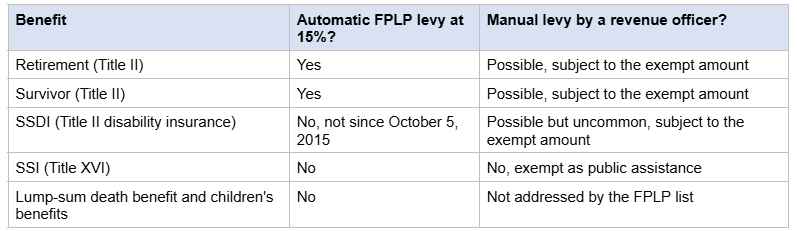
Retirement and survivor benefits. These are paid under Title II of the Social Security Act and are eligible for the FPLP at 15%.
Social Security Disability Insurance (SSDI). As of October 5, 2015, the IRS no longer systemically levies SSA disability insurance benefits through the FPLP, so the automatic 15% deduction does not apply to SSDI. A manual levy on disability benefits is still legally possible, subject to the exempt amount, but it is uncommon.
Supplemental Security Income (SSI). SSI is a needs-based benefit under Title XVI. The IRS does not levy it through the FPLP, and it is exempt from levy under Internal Revenue Code section 6334(a)(11), which covers public assistance payments. For more on this benefit, see our explainer, can the IRS take SSI income?
Other excluded payments. Lump-sum death benefits and benefits paid to children are not included in the FPLP.
Here is how the pieces fit together at a glance:
The IRS Internal Revenue Manual, section 5.11.6, describes the manual levy process on Social Security benefits.
The 15% cap versus a manual levy
The 15% figure applies to the automated FPLP. The IRS levies 15% even if the remaining benefit falls below $750, so don’t count on a minimum balance protecting your deposit from the levy.
Outside the FPLP, a revenue officer can issue a manual levy on Social Security benefits using Form 668-W. A manual levy is not limited to 15%, but the taxpayer can claim an exempt amount under Internal Revenue Code section 6334(a)(9). The IRS can levy retirement, survivor, and disability insurance benefits this way, but not SSI. Manual levies are uncommon and are generally handled by a revenue officer assigned to your account rather than the automated program.
For planning, treat 15% as the FPLP cap, and understand that leaving a balance unresolved can also lead to other collection tools, such as a federal tax lien. Either way, the sooner you respond, the more control you keep.
How much warning does the IRS give before levying Social Security?
A Social Security levy should not arrive without notice. Under Internal Revenue Code section 6330, the IRS must give written notice of your right to a hearing at least 30 days before it levies.
For Social Security, you typically receive a CP91 or a CP298. Both state that the IRS plans to take up to 15% of your benefits. The IRS explains the notice on its page about understanding your CP91 notice. The Social Security Administration cannot stop the levy or help resolve the tax problem—you must contact the IRS directly using the number printed on your notice. You must contact the IRS using the number printed on your notice.
The 30-day clock matters. Within that time, you can propose an alternative, such as a payment plan, or request a Collection Due Process hearing, where you can raise collection alternatives before an independent appeals officer. Many levies begin because someone set aside a notice as just one more IRS letter. Open every IRS envelope, and if you see the words “Final Notice” or “Intent to Levy,” treat it as urgent. For the full sequence of letters, see our guide to the notices the IRS sends before a levy.
What to do in the first 30 days
If a CP91, CP298, or final notice of intent to levy is already in your hands, this is a sensible order of operations:
Find the date on the notice and count 30 days forward. Write the deadline on a calendar.
Call the IRS, not Social Security. The Social Security Administration cannot stop the levy, so use the number printed on your notice.
Gather your paperwork using the checklist further down this page.
Decide whether to request a hearing. Request a Collection Due Process hearing on IRS Form 12153, which the IRS lists as a resource on its CP298 page. If you file on time, you can request alternatives such as a payment plan.
Ask for an arrangement that fits your budget. An installment agreement or a hardship request is easier to support when you can show your income and expenses on paper.
Missing the 30-day deadline doesn’t end your options, since a levy can still be released on the grounds listed in Internal Revenue Code section 6343. It does mean you may lose the hearing rights that come with a timely request.
How to stop or prevent an IRS Social Security levy
Internal Revenue Code section 6343 lists the grounds on which the IRS must release a levy, including an installment agreement and economic hardship. The right path depends on your income, balance, and monthly expenses.
Contact the IRS first. Call the number on your notice. If you can pay the balance in full, doing so ends the matter. If you cannot, ask about the options below.
Installment agreement. A monthly payment plan replaces an unpredictable 15% deduction with a payment you help set. For many fixed-income retirees, this is the most direct route. You can start with an installment agreement request on Form 9465.
Currently Not Collectible status. If a levy would leave you unable to pay for basic living expenses, you can ask the IRS to suspend most collection. Read how to qualify for Currently Not Collectible status before you apply. This status does not erase the debt. Penalties and interest continue to accrue, and refunds are applied to the balance.
Hardship release. If a levy has already started and is causing economic hardship, you can ask the IRS to release it under Internal Revenue Code section 6343.
Offer in Compromise. In specific situations, you can apply to settle for less than the full amount owed. It is not available to everyone, and acceptance is never assured. In fiscal year 2025, the IRS accepted 5,464 of the 38,797 offers submitted, about 14%, according to the IRS Data Book.
Collection Due Process hearing. If you have received a final notice of intent to levy, a timely hearing request lets you raise these alternatives before an independent appeals officer.
The right strategy turns on your numbers. The same $18,000 balance might point to an installment agreement for one retiree and Currently Not Collectible status for another, based on nothing more than the gap between income and necessary expenses.
What an IRS Social Security levy means for Michigan and Florida retirees
Levy & Associates serves retirees in both states, and the federal levy rules are the same everywhere. What differs is how state taxes sit alongside them.
Michigan
For retirees in Lathrup Village, Southfield, and across Oakland County, an FPLP levy is a federal action. Resolving it does not resolve a separate debt to the Michigan Department of Treasury, which collects through its own notices, deadlines, and payment programs. If you owe both, you need to address both agencies.
On the tax side, Michigan has always allowed a deduction for Social Security benefits included in federal adjusted gross income. Under Public Act 24 of 2025, taxpayers born after 1952 who are 67 or older can claim that deduction and the full standard deduction for tax years 2026 to 2028, as explained in the Michigan Treasury notice on PA 24 of 2025. For the details, see our guide to the Michigan retirement income deduction.
Florida
Florida does not impose a personal income tax, so you won’t pay state income tax on your benefits or a state income levy on top of the federal one. If you owe a business or sales tax debt to the state, that is a separate matter.
The IRS applies the same levy rules in Delray Beach and Palm Beach County as anywhere else. Our attorneys are licensed in Michigan, and Treasury Circular 230 permits federal tax representation before the IRS in any state for attorneys, CPAs, and Enrolled Agents. Florida retirees can read about Levy & Associates in Florida or call 877-620-6490.
A note on the current IRS landscape
Because the FPLP is automated, it keeps running. A levy that has started will not pause because you were unaware of it, and the 10-year period the IRS has to collect a tax after assessment, set by Internal Revenue Code section 6502, keeps running while you wait. Acting on the first notice is almost always easier than responding after several months of reduced payments.
A real-world example: a Southfield retiree
Consider a hypothetical retired homeowner in Southfield who receives $2,000 a month in Social Security retirement benefits. He owes the IRS about $18,000 in back taxes from a few years of underpayment. He sets aside a couple of letters and then receives a final notice of intent to levy. He lets the 30 days pass without acting.
The next month, his benefit drops by $300, the full 15%, and it keeps dropping every month after that. When he finally reviews his options, his monthly living expenses leave almost no breathing room. He asks the IRS for an installment agreement sized to his budget. Entering an installment agreement is one of the grounds on which the IRS must release a levy.
This example is illustrative only; figures are hypothetical, every case turns on its own facts, and prior results do not guarantee a similar outcome.
A second hypothetical shows how the same rules can lead to a different outcome. Consider a retired widow in Delray Beach who receives a survivor benefit and owes the IRS a balance from a prior year. After a final notice of intent to levy, she reviews her budget and finds that after rent, medication, and utilities, nothing is left over each month. Instead of a payment plan she cannot keep, she could ask the IRS to place her account in Currently Not Collectible status. Whether the IRS agrees depends on its review of her finances, and even if it does, penalties and interest keep accruing, so the balance does not go away.
This example is illustrative only; figures are hypothetical, and results depend on your facts. Prior results do not guarantee a similar outcome.
What to gather before you call
Having the right paperwork in front of you makes a first call far more productive. Try to pull together:
The most recent IRS notice, especially anything labeled Final Notice, CP91, or CP298, with the date it was issued
Your Social Security award letter or a recent benefit statement showing your monthly amount
A simple list of monthly living expenses, including housing, utilities, food, insurance, and medical costs
Any earlier IRS letters about the balance, even ones you set aside
For Michigan residents, any separate notices from the Michigan Department of Treasury
With these, a tax professional can compare your balance to your IRS account records, confirm the exact deadline you are working against, and identify which options fit your situation.
Frequently asked questions
Can the IRS take my entire Social Security check?
Not through the automated Federal Payment Levy Program, which is capped at 15% of each retirement or survivor payment. A manual levy by a revenue officer is not limited to 15% but must leave an exempt amount, and it is uncommon.
Can the IRS garnish Social Security disability (SSDI)?
Since October 5, 2015, the IRS no longer automatically levies SSDI through the Federal Payment Levy Program. A manual levy on disability benefits remains legally possible, subject to the exempt amount.
Can the IRS take SSI?
No. Supplemental Security Income is not levied through the FPLP and is exempt from IRS levy by statute as public assistance.
How much notice does the IRS give before levying Social Security?
You receive a final notice, typically a CP91, stating the IRS intends to levy up to 15% of your benefits, and you have 30 days to respond or request a Collection Due Process hearing. The Social Security Administration cannot stop the levy; you must contact the IRS.
How do I stop an IRS levy on my Social Security?
Set up an installment agreement, request Currently Not Collectible status if you cannot meet basic living expenses, or ask for a hardship release. The IRS must release a levy once you enter an installment agreement or show economic hardship.
How Levy & Associates can help
Our team includes Michigan-licensed attorneys, Certified Public Accountants, Enrolled Agents, and former IRS Revenue Officers. Because several of our professionals worked inside the IRS, we understand how collection works and where there is room to negotiate. We help retirees across Michigan and Florida respond to levy notices, set up payment structures that fit a fixed income, and request levy releases.
If the IRS has sent a notice threatening your Social Security benefits, call 248-557-4048 for a confidential conversation or contact us online.
Levy & Associates handles civil tax matters only and does not represent clients in criminal tax matters of any kind. This page is general information, not legal, tax, or employment advice. Reading it does not create an attorney-client relationship. Prior results do not guarantee a similar outcome. Examples are illustrative, and every case turns on its own facts. No outcome is guaranteed.
Contact Levy & Associates for Dependable Tax Audit Services
Levy & Associates is available for free initial consultations. We’re happy to answer any questions you have about the audit process or address any concerns about your specific situation.
There’s never a good time to be audited, and the time-consuming process will take away from your business or family if you try to face it alone. Let us handle and coordinate communication, so you can return to your daily life.